
Harnessing Data to Transform Trail Building
We are all attracted to the trails industry for different reasons, working in nature, creating something from nothing, helping others connect to nature through trails, whatever it is, the underlying drivers that motivate us all to create awesome trail experiences are based on creating more great experiences in the world.
When I look at my journey to the trails industry, I can see that my early years growing up on a farm in Queensland, Australia instilled in me a passion for the outdoors and I have managed to combine this with a number of careers have given me the opportunity to work in this great industry.
Over the past couple of years, we have helped to project manage the delivery of over $8 million of trail projects, developed a bunch of master plans, developed and implemented trail management system frameworks for clients across the east coast of Australia, and audited more trails than I can remember.
During this time there are a couple of key trends that I am seeing emerging. Most of these trends will ultimately be great for the industry and trails in general, a couple not so good, but all will require people in the trails industry to look at how they currently work, and make the required tweaks to stay on point, and importantly for the audience of this magazine, to maintain profitability.
This article will explore the need to harness data to transform trail building.
In any business operating today, harnessing the power of data is no longer just a competitive advantage but a necessity. As trail construction projects grow in complexity and scale, integrating robust data collection, analysis, and visualization practices into day-to-day operations is crucial. Applying a robust data strategy approach not only boosts profitability and efficiency, but also improves risk management, enhances team collaboration, and provides a clearer visibility of ongoing projects.

Building Data Collection into Day-to-Day Operations
Let’s be honest, most of us don’t get into the trail industry so we can do paperwork or collect data. Knowing how important data is however, we need to implement strategies to make the collection of data easy and part of our day to day routines.
There are so many moving parts in a trail building or tail management organisation, keeping track of them all can be overwhelming. However, there are so many Apps and platforms available to us, we are really only making excuses as to why we are not collecting data. Your mobile phone is probably already collecting a bunch of data you can use, its just a matter of collecting the data with the right App.
We should be tracking data from the moment we receive a request for tender or are awarded a package of work. A few examples would be; what criteria do we use to decide what tenders we respond to, how long does it take for us to write a tender, what is our strike rate on certain types of tenders, how effective was our onboarding process, how many yards per day are we building in different soil types, when is our plant due for servicing, what is our weekly break even numbers, what are our most profitable jobs, and the list goes on.
To seamlessly integrate data collection into daily operations, the following steps should be considered:
Establish systems and processes – capture how your organisation operates, who does what and when, the standard process steps, the forms, templates and technology you use and why.
Set clear objectives – start with the end in mind, define what data is needed and why. What are your key pain points and what data do you need to understand the root cause (not gut feel). This helps in collecting data that is relevant and valuable for analysis.
Leverage your existing platforms – we are all using platforms to manage our businesses, from the Microsoft or Google sweet, cloud based project management platforms like Airtable or Monday, accounting packages like Xero and Quickbooks, we are already collecting a lot of data.
Automate data entry where possible – Use mobile apps and other digital tools to record data in real time directly from the field. This reduces the likelihood of errors and omissions that are common with manual data entry.
Train your team – Ensure that all team members understand the importance of data collection and are trained on how to use data-gathering tools effectively, this may seem like a challenge at first, but the payoff will be worth the pain.
Creating Models to Analyze Your Data
Collecting data is the first step; the real value lies in analyzing this data to make informed decisions that drive business growth and operational efficiency.
This step does not need to be as scary as it sounds; lots of the platforms you already use have methods of analysing your raw data and presenting the data to you as information that you can use.
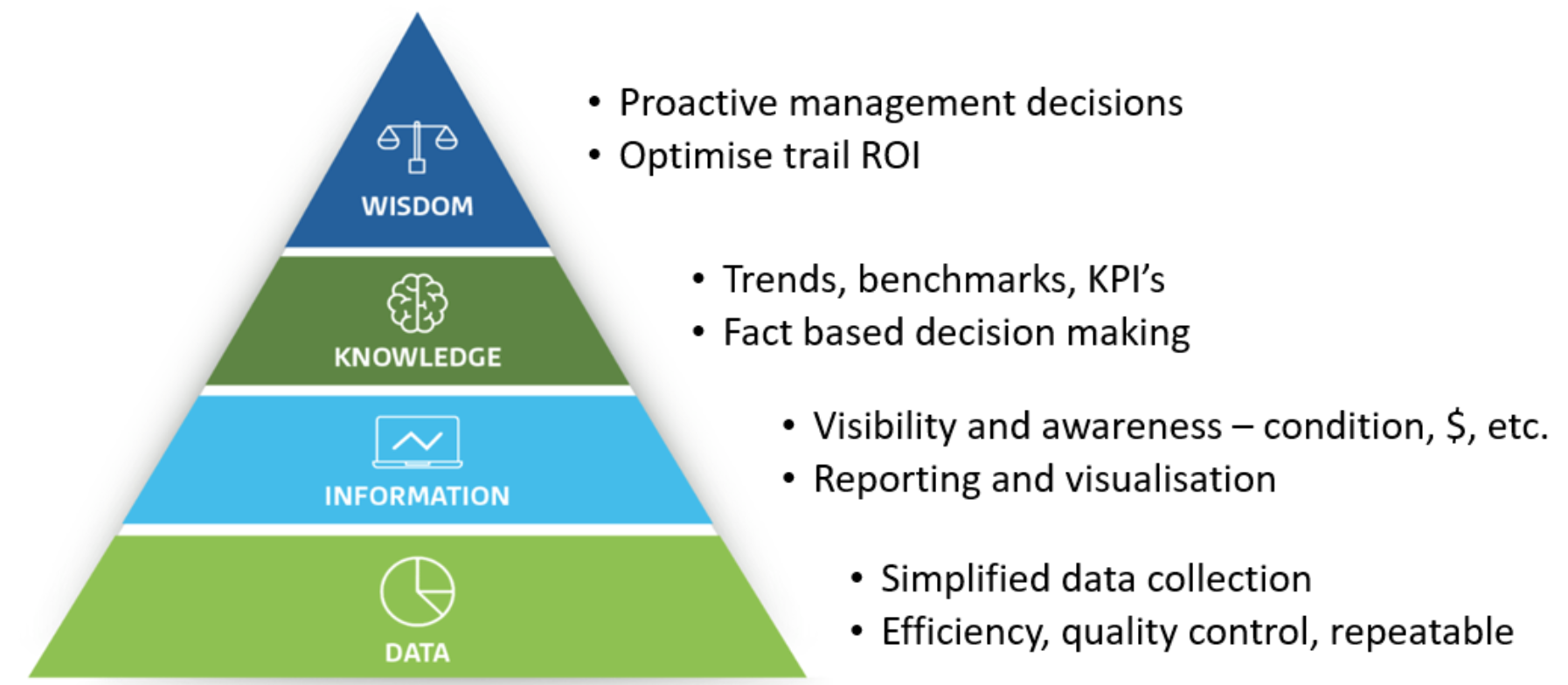
I will jump to a bit of theory here in relation to the DIKW pyramid; this is a visual representation of how data is transformed into wisdom in four key steps, as shown below.
Back to trail building, your CRM will give you data on your strike rate for tenders, your accounting software will tell you how long you are spending on tender writing, your project management software will tell you which type of trails you build best, your on-ground trail management software will tell you your yardage rate for each trail you build and for each of your build teams.
The key elements for data analysis include:
Establishing KPI’s for your organisation – identifying metrics that are crucial for assessing the performance of different aspects of your business, tender success rate, $/yard, team utilization, plant utilization, client satisfaction, safety incidents, etc.
Leveraging platforms for analysis – while spreadsheets are good for collecting and storing data, platforms that integrate data analysis to create information are a game changer, and you are probably already using them.
Identifying trends – data analysis will provide trends and patterns in your organisation, good or bad, these trends provide an insight into how your organisation is performing, and the areas where improvements can be made.
Actually doing it – we work with a lot of organisations who spend time to set up data collection and analysis systems and processes only to leave them on the shelf and continue on with business as usual. Establishing monthly, quarterly, and annual rhythms to review organisational performance is critical.
Creating ways to Visualise Data
Data visualization transforms complex datasets into clear and intuitive graphical representations, making it easier to identify trends and guide strategic decisions quickly.
Visual representations tell stories, they allow issues and opportunities to be communicated within and between levels in an organisation, and importantly to clients when required to demonstrate why a certain approach is required to address a trail issue.
The primary visualization techniques at our disposal are:
Dashboards – develop and implement that provide at-a-glance views of key metrics tailored to the needs of different stakeholders, from individual teams through to executive teams, and clients where relevant.
Mapping – use mapping to show construction progress, location of issues or work packages, and for planning and estimating new trail builds.
Reports – including graphs and pie charts in reports to visualise trends and achievements against KPI’s, this is more engaging than a report full of words.
Benefits of Applying a Data-Driven Strategy
There are a stack of benefits to be gained from applying a data driven strategy in your organisation, some will be similar to other organisations while others will be directly relevant to your organisation.
I have identified the following key benefits of applying a data driven strategy to your organisation:
Increasing profit – what jobs or services are the most profitable for your organisation.
Managing risk - Data helps to identify potential risks early in a project lifecycle, allowing for timely intervention and mitigation.
Improving efficiency - Analyzing operational data enables organisations to streamline processes, reduce downtime, and enhance productivity.
Increasing Team Collaboration – Shared data insights can help to create a collaborative work environment, as team members are better informed and aligned with project goals and progress, this is not a bad thing for creating a bit of friendly competition between trail building crews as well.
Providing greater visibility of work in play – Data visualization tools help stakeholders understand the status and details of projects at a glance, improving transparency and communication of issues.
Better planning – Data-driven insights allow for more accurate forecasting and resource allocation, ensuring that projects are well planned and costed appropriately.
Creating benchmarks – Historical data from past projects can be analyzed to set benchmarks that guide the planning, costing, and delivery of future projects.
Choosing the right projects – Analyzing profitability by project type or client type can help organizations focus on the opportunities that are most profitable or provide the best overall return on investment for the organisation.
Wrapping up
The integration of data collection, analysis, and visualization into the day-to-day operations of trail building organisations is not just about keeping up with technology—it’s about actively leveraging these tools to enhance every aspect of the organisation, from profitability to operational efficiency, and risk management.
Organisations who embrace a data-driven approach will not only set new industry standards but will also enjoy sustainable growth and success in an increasingly competitive market.
By embedding the collection, analysis, and implementation of data within their organisation, they position themselves as innovative leaders, ready to meet the challenges of modern trail construction, and confident in their ability to deliver world class trail outcomes.

Craig Meinicke
Craig is the founder of Blue Sky Trails, a trail development and management consultancy. The Blue Sky Trails team operates under the mission of creating the right trail, in the right place, for the right reasons, with systems in place to manage them effectively.
To support this mission, Craig founded a software company called Trail Vision that facilitates the collection, analysis, and presentation of trail data to create compelling stories that enable proactive decision-making.
Craig was chair of the working group that developed the Australian Mountain Bike Trail Guidelines and regularly gets his hands dirty supporting local trail volunteer groups to build and maintain mountain biking trails.
